Custom AI 3D model — a new service at 3DShop.si
Two years ago, creating a 3D model was a manual craft — Blender, ZBrush, days of modeling. Today AI generates a print-ready 3D mesh from a photo in a few minutes. We are launching the AI 3D model service, which brings this workflow to Slovenia with reasonable prices and professional cleanup.
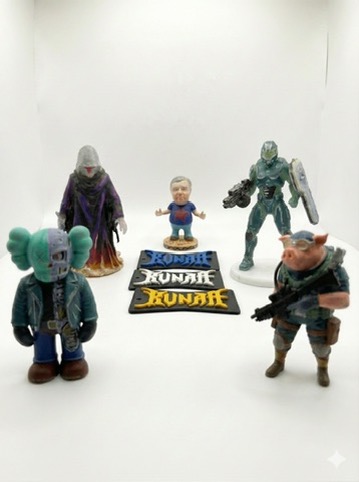
What is AI 3D generation and how do we use it?
AI 3D generation is a process in which specialized models convert 2D inputs (photos, sketches, text descriptions) into 3D mesh models. Under the hood they use diffusion architectures and NeRF technology — much like Midjourney generates images, these models generate 3D meshes. The result is an STL or OBJ file suitable for 3D printing, games, visualizations and further work in Blender or ZBrush.
The reason we use specialized AI platforms instead of our own trained models is economies of scale. AI labs invest millions in development and optimization — we focus on what we do best: cleanup, optimization for 3D printing and integration with the Slovenian market. For each project we choose the platform that gives the best result for the specifics of the object.
AI generates about 70% of the final model. The remaining 30% is manual cleanup — repairing holes in the mesh, retopology for 3D printing, refining details, a UV map for textures. Without this step, the model most often will not be printable.
What can we generate a 3D model from?
The input determines how accurate the result will be. More references = a better model.
- Photograph — 1 to 4 photos of the object from different angles. The best results come with objects that have a distinctive silhouette (toys, collectibles, pieces of architecture). Worse with transparent or very mirror-like surfaces.
- Sketch or technical drawing — hand-drawn or drawn in a vector format. AI converts 2D lines into a 3D shape. Ideal for concept art and inventors' ideas.
- Text description — e.g. "a medieval sword with runic ornaments, length 30 cm, a curved blade". AI generates from the description. Less accurate than with a reference, but useful for rapid prototyping.
- An existing 3D model — cleanup, remix or format conversion. With AI we can improve the topology of an old model or adapt it for 3D printing.
Our workflow in 4 steps
You send a photo / sketch / description. You choose a package. We qualify whether the case is feasible.
A specialized AI platform generates the first mesh. Two free regenerations are included if the result is not satisfactory.
We close holes, fix the topology, refine the details. With the Optimized package, a UV map as well.
STL/OBJ by email in 24–72 hours. With 3D printing added — a physical model in 7–10 days.
Pricing structure — deliberately affordable
We have set the pricing so that it is cheaper than hiring a 3D modeler by the hour, while still delivering a professional result. The three main options:
- Basic STL — €15 · 24–48 hours · STL only with basic cleanup
- Optimized STL/OBJ — €29 · 48–72 hours · manual cleanup, UV map, optimization for printing
- STL + 3D printing — from €39 · 7–10 days · file + a physical printed model
Everything includes a commercial license: you can sell, print and use the model in presentations without additional fees. Details and surcharges for larger formats can be found on the AI 3D model price list page.
Who is this service for?
The most common customers we expect:
- Makers and hobby 3D printers — custom miniatures for D&D, Warhammer, RC models, hobby prototypes.
- Designers and graphic studios — converting concept art into a 3D mesh for client visualizations.
- Architects — 3D reconstruction of existing buildings from photos for a model or presentation.
- Marketing teams — product presentation models, scale prototypes, packaging ideas before a CAD designer.
- Inventors — converting an idea into a physical prototype — with an AI model and printing in one package.
The difference between AI generation and manual modeling
Honestly: AI does not replace a professional 3D modeler for demanding projects (very precise mechanical parts, organic anatomy with perfect topology, animations with a rig). For that we still employ ZBrush specialists. But AI is excellent for:
- A quick prototype or idea ("would this even work in 3D?")
- Static decorative objects (that will not need to be animated)
- Models that will be printed at a small size (where micro-details are not noticeable)
- Cases where time matters more than perfection
A customer wanted a 3D model of their father's rocky-style toy for his 70th birthday — an old wooden tool with sentimental value. They sent 3 photos. The AI generated the first version in 30 minutes. After 90 minutes of manual cleanup, we had a print-ready STL. In total, 2 hours of work instead of 8–12 hours of classic modeling. Price for the customer €29, turnaround time 36 hours.
How do you get started?
The simplest way: send your input material (an image, sketch or description) via our contact form with a description of the project. Within 24 hours we return an assessment of feasibility and the expected result. If the case is a good fit, you receive a preview within the next 24–48 hours, and the final STL after your confirmation.
More details about the process: How to order an AI 3D model.
Generate your first AI 3D model
Send an image, sketch or description — you get a preview in 24 hours and the final file in 48–72 hours.
Send an inquiry